
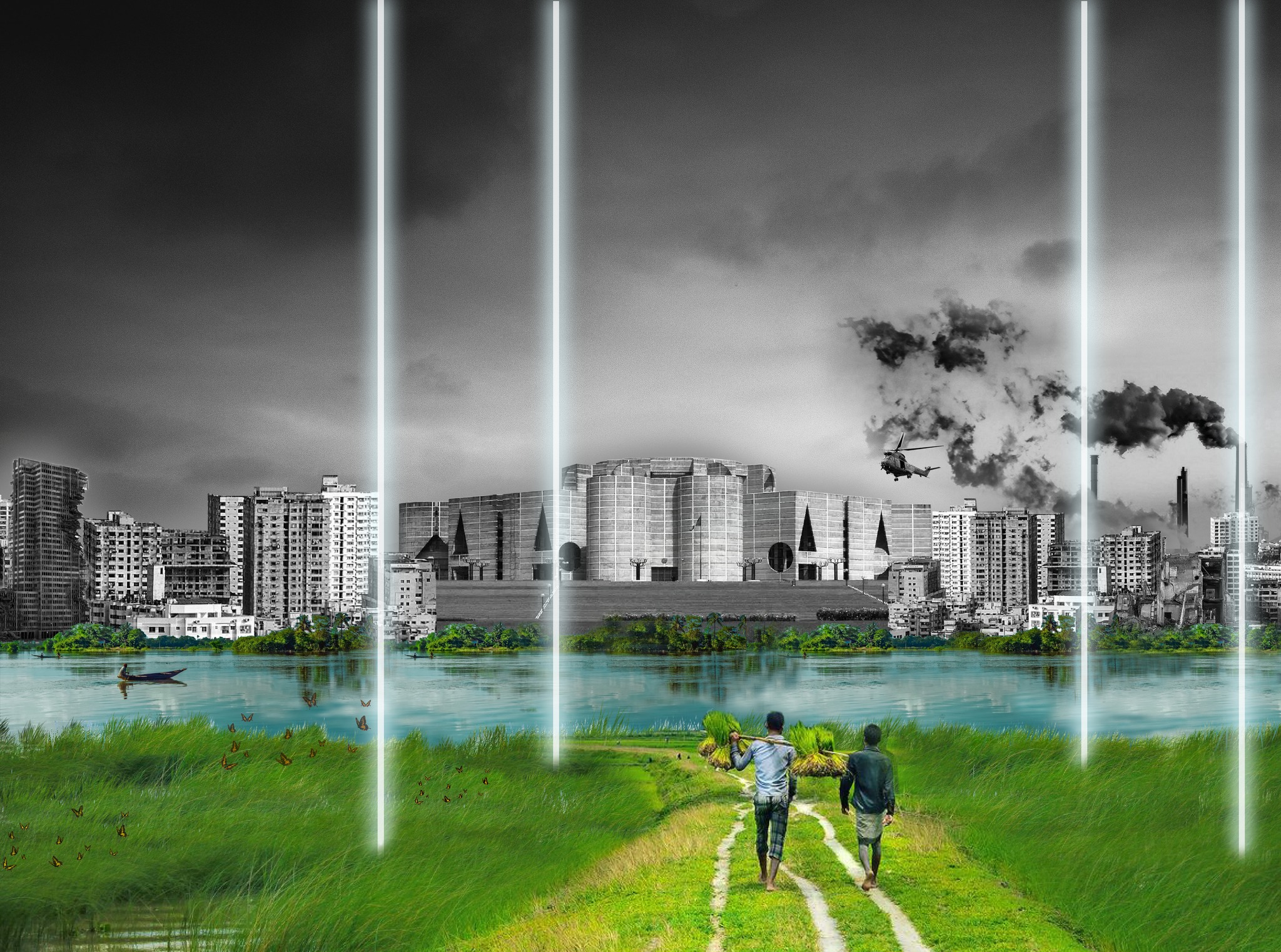
The contemporary imagination of digital technology is built around disappearance. Data becomes “cloud,” labour becomes automation, infrastructure becomes a platform, and the physical world is increasingly described through the language of information. The promise of digitalisation is therefore often presented as a movement away from materiality: less physical infrastructure, less human intervention, less friction and greater efficiency. Yet this apparent dematerialisation is misleading. Digital systems do not eliminate material infrastructures; they reorganise and conceal them.
Artificial intelligence, algorithmic governance and digital platforms depend upon buildings, electrical networks, telecommunications infrastructure, cooling systems, labour and vast territories of physical hardware. What changes is not the material existence of infrastructure, but its visibility. The digital condition produces a particular form of latent infrastructure: systems that are physically present but socially and architecturally difficult to perceive.
This condition becomes particularly significant in Bangladesh. The country’s digital transformation is taking place within an uneven landscape of industrial production, informal economies, infrastructural deficiencies, environmental vulnerability and highly differentiated access to technology. The question is therefore not simply whether Bangladesh is becoming digital. The more critical question is:
What becomes visible, measurable and governable when Bangladesh becomes digital, and what becomes invisible in the process?
The National Artificial Intelligence Policy 2026–2030 already identifies infrastructure, data governance, labour and employment, public services and human oversight as critical areas of AI development (ICT Division, 2026). This indicates that AI is no longer merely a computational issue. It is becoming a question of infrastructure, institutions and spatial organisation.
Digitalisation does not make infrastructure disappear.
It redistributes its visibility.
From the Cloud to the Factory
The idea of the “cloud” is useful precisely because it hides its physical condition. Data does not exist in an abstract cloud. It exists within servers, cables, buildings, electrical systems and territories. Similarly, artificial intelligence does not operate outside architecture. Its computational processes require an extensive physical environment.
In Bangladesh, however, the most significant physical infrastructure of digital transformation may not be the large data centre. It may be the factory.
The ready-made garment industry provides a particularly revealing example. Bangladesh’s garment sector is increasingly incorporating automated machinery, digital production systems and networked monitoring technologies. These systems can measure worker output, machine idle time and production efficiency in real time (Papri, 2025).
At first glance, this appears to be a straightforward story of technological progress.
But something more fundamental is occurring.
The relationship between worker, machine and space is changing.
Traditional factory management depended heavily upon physical observation. Supervisors moved through production spaces, watched workers, identified delays and responded to problems. Digital monitoring allows this observation to become continuous and quantified. The worker no longer needs to be physically watched to become visible to management.
Their activity becomes data.
The factory consequently becomes more than a space of production.
It becomes a computational environment.
The machine does not simply manufacture garments. It also produces information about the worker, the production line and the performance of the factory itself.
This creates a fundamental shift in architectural politics. The factory is no longer only organised around the movement of people and materials. It is increasingly organised around the movement of data about people and materials.
The Worker as a Dataset
The most important consequence of digital monitoring is not necessarily automation itself. It is the transformation of human activity into measurable variables.
A worker can be represented through output per hour, target deviation, machine idle time, attendance and production rate. These variables may be technically useful, but they inevitably reduce a complex human condition into a limited computational representation.
This is where data becomes political.
A worker who moves slowly can be classified as inefficient. A production line that deviates from an expected rhythm can become an anomaly. A period of inactivity can become a performance problem.
But the system cannot automatically understand why these conditions occur.
The worker may be physically exhausted.
The machine may be malfunctioning.
The production target may be unrealistic.
The factory environment may be uncomfortable.
The worker may be performing an activity that is necessary but not captured by the metric.
The computational system nevertheless requires these complex situations to become measurable.
This illustrates a broader problem of algorithmic governance. Data-driven systems do not simply observe reality. They construct categories through which reality becomes administratively legible (Kitchin, 2014; Amoore, 2020).
The question is therefore not whether the system can measure the worker.
It is:
What happens when the measurement becomes more authoritative than the worker’s experience?
From the Factory to the City
The same transformation is occurring at the urban scale.
The smart city imagines the urban environment as a computational system. Sensors collect information, algorithms process it, platforms coordinate infrastructure and government services become increasingly data-driven.
For Bangladesh, this promise is particularly attractive. Dhaka faces congestion, flooding, inadequate infrastructure, rapid population growth, informal development and fragmented public services. The possibility of using data to coordinate such complexity appears inherently desirable.
Yet there is a fundamental difference between making a city measurable and making a city better.
Dhaka can be represented through traffic data, satellite imagery, land records, demographic statistics, environmental measurements and mobility patterns. But an enormous quantity of urban data does not automatically produce an effective city.
A city can therefore become:
computationally legible while remaining physically dysfunctional.
This distinction is crucial.
If a traffic system measures only vehicle movement, pedestrians can disappear from the model.
If urban development is evaluated through land value, informal communities can become “underutilised” land.
If flood management is evaluated only through hydraulic performance, community-based adaptation can become invisible.
If housing demand is reduced to numerical requirements, social relationships and cultural practices can disappear from the planning model.
The problem is therefore not simply a lack of data.
It is the politics of what data chooses to represent.
The Digital Production of Territory
The transformation of land administration provides another important example.
Bangladesh has invested heavily in the digitisation of land records, cadastral information and land-management services. Recent initiatives have sought to digitise and verify millions of land-related records (Ministry of Land, 2025; UNDP Bangladesh, 2025).
Digitisation can clearly provide benefits. It can improve accessibility, reduce administrative delays and potentially reduce opportunities for corruption.
But a digital land record does not simply represent territory.
It produces a particular administrative interpretation of territory.
A parcel represented as a clean polygon appears stable and objective. Yet the social reality of land in Bangladesh can involve inheritance, informal occupation, competing claims, family relationships, historical documents and political influence.
The map can therefore appear more certain than the territory itself.
This distinction is important because digital systems tend to privilege information that can be standardised. What cannot be easily classified becomes difficult to represent.
The result is not necessarily that these realities disappear.
They become computationally marginal.
Recent research on rural Bangladesh demonstrates this tension by showing how fiscal data emerge through interactions between physical records, digital systems and social negotiation. Data are not simply collected from reality; they are produced through institutional and social processes (Ahmed, 2026).
The database therefore does not merely record the village.
It produces a new administrative version of the village.
The Politics of Visibility
Digitalisation is frequently described as a process of increasing visibility.
But visibility is not always liberating.
Visibility can also become a mechanism of control.
A worker becomes visible through productivity data.
A citizen becomes visible through administrative databases.
A parcel becomes visible through cadastral mapping.
A vehicle becomes visible through tracking systems.
A neighbourhood becomes visible through satellite imagery.
The important question is what happens to everything that does not fit these systems.
The informal worker.
The undocumented household.
The disputed land claim.
The unregistered settlement.
The social relationship that cannot be represented as a variable.
The form of knowledge that exists through memory, practice or oral negotiation.
These conditions are not necessarily absent.
They are digitally deferred.
They remain materially present while becoming computationally peripheral.
This produces an important contradiction. Digital systems create an appearance of completeness because everything within the system can be counted, mapped or classified. Yet the completeness belongs to the database, not to reality.
The model is never the territory.
The map is never the city.
The dataset is never the worker.
The simulation is never the society.
Bangladesh: Hyper-Digital and Hyper-Physical
Bangladesh presents a particularly interesting condition because digitalisation does not simply replace physical practices. Digital and analogue systems frequently coexist.
Paper records exist alongside databases.
Manual labour exists alongside automated machinery.
Informal markets exist alongside formal logistics.
Cash exists alongside mobile financial systems.
Human negotiation exists alongside algorithmic classification.
Traditional construction practices coexist with computational design.
This hybridity should not necessarily be understood as technological backwardness.
It can instead be understood as a form of infrastructural intelligence.
A digital system may depend upon physical verification.
A land database may depend upon local knowledge.
A smart factory may depend upon workers who understand machines through years of embodied experience.
An urban model may depend upon knowledge that never appears in official datasets.
This suggests that Bangladesh’s digital future should not be understood simply as a transition from analogue to digital.
It is more accurately understood as a process of negotiation between computational and non-computational forms of knowledge.
The distinction matters because technological transformation becomes dangerous when it assumes that everything valuable can be converted into data.
Some knowledge exists precisely because it is contextual, embodied and relational.
Architecture as an Interface of Power
This condition demands a different role for architecture.
Architecture should not merely provide physical space for digital technology.
It should interrogate the systems of power that digital technology produces.
The conventional smart-building paradigm asks:
How can technology make the building more efficient?
A critical computational architecture asks:
What forms of power become embedded when the building becomes computational?
This distinction is especially important in Bangladesh.
A technologically advanced factory may increase productivity while intensifying worker surveillance.
A smart city may improve traffic management while increasing behavioural monitoring.
A digital land system may improve administrative efficiency while marginalising forms of ownership that are difficult to encode.
A computational housing system may generate thousands of plans while embedding assumptions about what constitutes a “normal” household.
Technology therefore has no inherently democratic or progressive political direction.
It amplifies the institutional structures into which it is inserted.
Toward a Critical Computational Architecture
For computational design in Bangladesh, this suggests a research agenda beyond optimisation.
The architect should not simply ask how algorithms can generate more efficient buildings.
The architect should also ask what assumptions are encoded inside the algorithm.
A factory simulation could represent not only material flows but worker surveillance.
An urban model could represent informal movement alongside formal transportation networks.
A housing algorithm could reveal how its assumptions about family structure affect spatial outcomes.
A flood simulation could incorporate community knowledge rather than treating residents merely as variables.
A land-use model could represent uncertainty instead of presenting contested boundaries as objective facts.
In this sense, the computational model becomes a political instrument.
The model should not only ask:
What is the optimal configuration?
It should also ask:
Optimal for whom?
According to which metric?
Who defines the constraints?
Who provides the data?
Who benefits from optimisation?
Who becomes an error in the system?
These questions are particularly important as Bangladesh develops its national AI governance framework. The draft National AI Policy 2026–2030 places considerable emphasis on responsible, inclusive and human-centred AI, while identifying data governance, infrastructure, employment and public services as key areas of intervention (ICT Division, 2026).
However, governance cannot be limited to policy documents.
It must also be embedded in the physical and spatial environments where computational systems operate.
The politics of AI is therefore also a politics of architecture.
From Digitalisation to Digital Accountability
The central challenge for Bangladesh is not whether it should adopt AI.
Digital technologies will increasingly shape manufacturing, administration, transportation, land management, education and urban development regardless of whether architecture engages with them critically.
The more important question is how these systems should be designed and spatially embedded.
Digitalisation should not mean that every social condition must become measurable.
Automation should not automatically mean that every human activity should become optimisable.
Data should not automatically become authority.
A computational model should remain visibly incomplete.
Its assumptions should be exposed.
Its exclusions should be identifiable.
Its decisions should remain contestable.
This is where architecture can make an important contribution.
Architecture operates between abstract systems and material reality. It translates numbers into spaces, policies into infrastructures and technological systems into everyday environments. Computational architecture therefore has the potential to become a critical discipline capable of revealing what digital systems otherwise conceal.
Conclusion
The most important architecture of artificial intelligence may not be the spectacular data centre.
It may be the ordinary factory where a worker’s activity becomes a number.
The government office where a household becomes a record.
The cadastral map where land becomes a polygon.
The street where movement becomes a dataset.
The housing algorithm where a family becomes a set of spatial requirements.
The city where social complexity becomes an optimisation problem.
These are spaces of latent presence: environments in which computational power becomes embedded into everyday life while remaining largely invisible.
For Bangladesh, this condition demands a shift in how digital transformation is understood.
The objective should not simply be to make the country smarter.
It should be to make the politics of smartness visible.
The critical computational architect therefore has a responsibility not merely to design better algorithms, but to interrogate the realities that algorithms make visible and invisible.
The future of computational architecture in Bangladesh should consequently move beyond efficiency, automation and optimisation toward accountability, plurality and spatial justice.
The question is no longer whether architecture will become computational.
It already is.
The question is whether architects will remain designers of the spaces in which computational power operates, or become active participants in determining what that power is allowed to see, measure, classify, optimise and transform.
The digital has never been immaterial.
It has simply deferred its presence.
References
Ahmed, S. (2026). Data stitching: Fiscal data sociality in rural Bangladesh. Economy and Society. https://doi.org/10.1080/03085147.2026.2675177
Amoore, L. (2020). Cloud Ethics: Algorithms and the Attributes of Ourselves and Others. Duke University Press.
ICT Division, Government of Bangladesh. (2026). National Artificial Intelligence Policy of Bangladesh 2026–2030: Draft V2.0. Government of Bangladesh.
Kitchin, R. (2014). The Data Revolution: Big Data, Open Data, Data Infrastructures and Their Consequences. SAGE Publications.
Ministry of Land, Government of Bangladesh. (2025). Digital Land Management System. Government of Bangladesh.
Papri, J. (2025, March 6). As Bangladesh’s factories turn to surveillance and automation, garment workers feel the pressure. Rest of World.
UNDP Bangladesh. (2025, August 13). Large-Scale Pilot to Digitize Land Records Launched in Feni. United Nations Development Programme.
UNESCO. (2026). Bangladesh: Global AI Ethics and Governance Observatory. UNESCO.